
IBM Replication always guarantees table consistency, that is, all data in the target table is actually committed in the base table. IBM Replication also provides consistency across sets of tables with the replication subscription, which can have multiple, related members. These members are the source and target pairs; and the members are usually bound by transaction relationships.
Because the replication members have something in common, the changed data needs to be copied in the same unit of work. Each replication subscription has a name and is identified by a row in the subscription set control table. A replication subscription with replica tables has two rows, one for each direction of copying (from source to replica and replica to source).
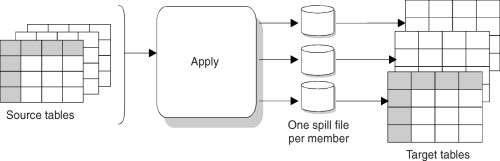
Figure 11 shows the relationship of the replication subscription with the Apply program.
Figure 11. Replication Subscriptions and the Apply Program
|
The Apply program reads changes from the replication source or CD table and creates one spill file created for each table. The Apply program replicates the changes to the target tables.
The replication subscription helps maintain referential constraints that exist among a set of replication source and replica tables. The replication subscription also limits the boundary for cascade rejection due to RI violation or update collision. Finally, replication subscriptions keep the source-to-target definitions for all the components of a view target table together. The replication subscription should contain all target tables that are related, such as with RI constraints.
Replication Subscription Rules
The following section describes the rules and constraints you need to be aware of in planning and defining a replication subscription.
Rules for external programs that maintain CCD tables
If you want to maintain your own CCD table, you must update three columns: CCD_OLD_SYNCHPOINT, SYNCHPOINT, and SYNCHTIME. CCD_OLD_SYNCHPOINT is the SYNCHPOINT associated with the oldest row remaining in the CCD_TABLE, though this sequence number might be older if the CCD table is condensed and the oldest row was overwritten by a more recent update. SYNCHPOINT is a sequence value useful for maintaining the state of CCD copies, subscription states, and for controlling pruning. SYNCHTIME is the timestamp equivalent of SYNCHPOINT.
If the CCDs are maintained by a program external to IBM Replication, there is no source server or target server distinction (because the context is just one database).