|
|
|
|
|
|
|
|
|
|
|
| • |
Excitation-contraction
coupling in smooth muscle is believed to occur by two
|
|
|
mechanisms-electromechanical
and pharmacomechanical coupling.
|
|
| • |
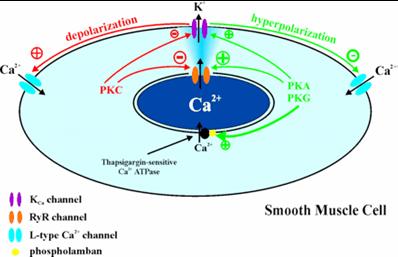
Electromechanical
coupling operates through changes in surface membrane potential;
|
|
|
typically resting
membrane potential= -40 to -70 mV.
|
|
| • |
Primary drive
for the rise in intracellular calcium is membrane depolarization, with the
|
|
|
consequential
opening of voltage operated calcium channels; neurotransmitters or
|
|
|
hormones acting
to depolarize the membrane will cause contraction while those
|
|
|
producing
membrane hyperpolarization will cause relaxation.
|
|
|
| • |
Like
cardiac muscle, the influx of Ca2+ likely causes release of Ca2+
from sarcoplasmic
|
|
|
reticulum.
|
|