 Columbia University in the City of New York
Search Columbia News
 RSS
RSS Story Ideas
 Newsletter


Vincent Guilamo-Ramos, assistant professor of social work, has been awarded a $430,000 grant from the National Institute on Alcohol Abuse and Alcoholism for development of an alcohol and HIV-prevention intervention for adults in the Dominican Republic.
The Mailman School of Public Health has been awarded $2.5 million from Google.org to accelerate the discovery of new pathogens and develop rapid response to outbreaks. The International Research Institute for Climate and Society will receive $900,000 from Google.org to improve the use climate data in Ethiopia.


 Read the November 2008 Columbia Alumni
Association Newsletter
This month's edition includes information about an election night special, a health and wellness seminar on autism and an online career networking panel discussion.
Election night is one of the most exciting times to be a journalist—the whole nation glued to their TVs, watching returns with bated breath as polling stations close and votes are tallied. This year, students at Columbia's Graduate School of Journalism will have their first taste of that thrill as they broadcast their own election night coverage on the Web.
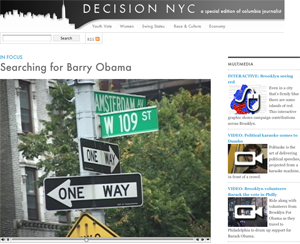
Indeed, this is the first time the journalism school has done full-scale coverage with cutting-edge technology including streaming audio and video reports from locations throughout New York City and several swing states, as well as interactive maps and audio slide shows. In past years, the journalism school has seized upon this occasion by producing a newspaper filled with election-related stories; last year, radio coverage was streamed online.
This year's entire election night package, which will be viewable by the public at columbiajournalist.org, will be put on the Web at these times: multimedia stories will run from 7 p.m. to 7:45 p.m.; audio/video coverage will run from 8 p.m. to midnight; and live Webcasts will run at 9:45 p.m. and 10:45 p.m.
"We wanted to make the most of this election for the students, not simply as just an educational exercise but to do some outstanding journalism that students would be proud of," said Bill Grueskin, dean of academic affairs at the journalism school and a former deputy managing editor of The Wall Street Journal. "Real-time election coverage that is open to the public heightens the stakes for these students. They are doing journalism which can be seen around the world."
Decision NYC will feature pre-packaged stories as well as live stories with reporters and producers on location throughout the city, including Harlem, Jackson Heights, Staten Island and the Bronx. In addition to pieces about election parties, students have found such off-the-beaten-path stories as one about a group of McCain supporters in Chinatown trying to drum up support and another on how election tchotkes—banners, t-shirts and buttons—travel from manufacturers to election headquarters and into the eager hands of supporters nationwide.
According to Duy Linh Tu, assistant professor of professional practice and one of the school's new media experts, the school's 2008 election night coverage takes advantage of the newest technologies that help expedite reporting as well as delivery of news to the public. "We're pushing new media, interactive maps, charts, audio slideshows, and live video," said Tu. "The whole package is new."
The coverage will require an all-hands-on-deck approach. Broadcast students will be helping to produce a live, four-hour election Webcast, and reporters on location in three swing states—New Hampshire, Pennsylvania and Virginia—will send in their stories live via new StreamBox technology, which will allow students in the field to stream live video to the election Web site.
Much of the team also will be working on a radio show called America's Choice. "We are trying to better understand the important issues driving voters' choices this year," said student Devin Dwyer. "Our reporters will be catching up with voters as they're leaving the polls, speaking with community leaders, and embedding in an array of ethnic communities around the area."
Participating in live, election night news production is an opportunity that comes once every four years, and students at the Journalism School are embracing Tuesday's live coverage with the focus and energy of practicing journalists. "It's a great exercise in journalism, and the students will have a marvelous lesson in the team effort it takes to report a huge breaking-news event like this," said Ann Cooper, director of the broadcasting program. "All the work will be done by students themselves, from reporting from the field, to hosting in the studio, to running the technology that puts the broadcast together for the world."
For one journalism student, Habiba Nosheen, a Canadian citizen specializing in broadcast journalism, the school's election night coverage is her way of participating in this global event. "I can't vote, so I feel like this is my way of taking part in an election that is so important," said Nosheen. "The best part has been interviewing and talking to people about what issues are important to them. The kind of conversations that are happening right now with a woman vice-presidential candidate and the first African-American presidential candidate makes it an exciting time to be part of this election. The class of '09 is very lucky to be part of this."

© Columbia University